The new MCP Contract Framework: more important than the GPFV

The recent NHS England document, “The Multispecialty Community Provider (MCP) emerging care model and contract framework” (which you can find here), is in Ben Gowland’s view a more important document about the future of General Practice than the General Practice Forward View (GPFV). He explains why.

The document describes how NHS England sees the future of General Practice. At the same time, the document is not written specifically about General Practice. This is because it is about MCPs, and an MCP is not a form of General Practice. Rather it is a new organisational form that includes General Practice. As such, it potentially represents the end of the independent contractor model of General Practice.

That’s a lot to take in, but I don’t think I am overstating it. I read the document expecting to find out more about the new voluntary GP contract that the then Prime Minister David Cameron had unexpectedly announced last year. But it turns out there is no new GP contract. The new contract is for MCPs, a new form of organisational entity,

An MCP is what it says it is – a multispecialty, community-based, provider, of a new care model. It is a new type of integrated provider. It is not a new form of practice-based commissioning, total purchasing or GP multi-fund, or the recreation of a primary care trust (PCT). An MCP combines the delivery of primary care and community-based health and care services – not just planning and budgets. It also incorporates a much wider range of services and specialists wherever that is the best thing to do.” p5.

General practice will become only one part of this new bigger organisation. What the document does is work through some of the detail of the new MCPs, and in particular how they will be contracted. While the primary focus of the document is not General Practice, the implications for General Practice are huge.

Now, before panic sets in, the model is entirely voluntary for General Practice. The document clearly states, “Under no outcome would GPs lose their right to continue to provide primary medical services against their will” p29. But that said, what exactly does the document say about the relationship between the new MCPs and General Practice?

First there is what looks like a ‘pre-qualifying’ phase. General Practice has to operate at a population level of at least 30,000, which, the document says, “is a natural first step towards an MCP, for example via super practices or GP federations” p20. It then says, “Working in groups of at least 30,000 patients enables general practice to be commissioned to take on new services and funding set out in the General Practice Forward View. These could include the provision of additional access, co-funding for the introduction of pharmacists within general practice, or infrastructure investment.”

I don’t know what to make of this. It hints the new investment in General Practice is only going to be available to groups operating at this scale, but maybe I am reading too much into it.

There are three types of contractual relationship GPs can have with an MCP. The first is through a “virtual” MCP contract. Here, the existing individual contracts of the GP practices and other providers of community services remain separate, but are then overlaid with what is essentially an agreement between all of them in which, according to the document, they “could establish a shared vision and a commitment to managing resources together, as well as clear governance and gain/risk sharing arrangements, together with an agreement about how services will be delivered operationally” p20.

The second type of MCP contract is described as “partially integrated”. Essentially all provider contracts are brought into a new single MCP contract, except the GP contracts. It could include elements of the GP contract, e.g. QOF, DES’s “by agreement”. These agreements could, “break down barriers and commit GPs to new ways of working (e.g. by working at scale, redesigning the workforce, and developing operational protocols)” p27.

The third and final type of MCP contract is “fully integrated”. All the provider contracts are brought into a new single contract, including the GP contracts. The contract will be 10-15 years in duration, and the DH has been asked to change legislation to create an option to enable GPs to return to G/PMS arrangements (p27). It will have a performance element that replaces QOF and CQUINs of approximately 10% of the contract value. The contract will be for the existing value of the commissioner spend for the services included for the population served. It will have gain/risk share arrangements that are yet to be determined.

Can GPs own and run an MCP organisation, and hold a “fully integrated” MCP contract? It would appear this option will be to open to very few. An MCP can in theory be a Limited Liability Partnership (LLP), a Community Interest Company (CIC), or a limited company. GPs could be partners or shareholders in these organisations, and as such be direct owners of the company. But not on their own, “it is quite likely that many existing organisations that deliver part of the proposed MCP service scope will be unable in isolation to be credible holders of a fully integrated MCP contract, and they will need to forge new partnerships” (p25). Only “stronger” federations or super-practices, the document says, “could then seek to develop into credible bidders” for MCP contracts (p20). The clear implication is very few GP organisations of any type will even be eligible. The document itself concludes, “Given that MCPs will be responsible for out of hospital services, the natural application of this option would be with existing Community Trusts or FTs” (p26).

And in this scenario (established in the document as the most likely) what happens to the GPs? Well, they either become employees of the new MCP, or subcontractors or independent contractors operating under a clinical chambers model. And what will their salary be? That will be up to the MCP, because, “there is no single new “contract” for individual GPs wanting to be part of an MCP arrangement” p28.

At present 8% of the country is covered by MCPs (although it should be said that 0% is currently covered by any sort of MCP contractual agreement). By next year the document states that national coverage will expand to 25%. The expectation is that a quarter of the country, and therefore a quarter of General Practice, will by next year will at least be moving towards these new contractual agreements.

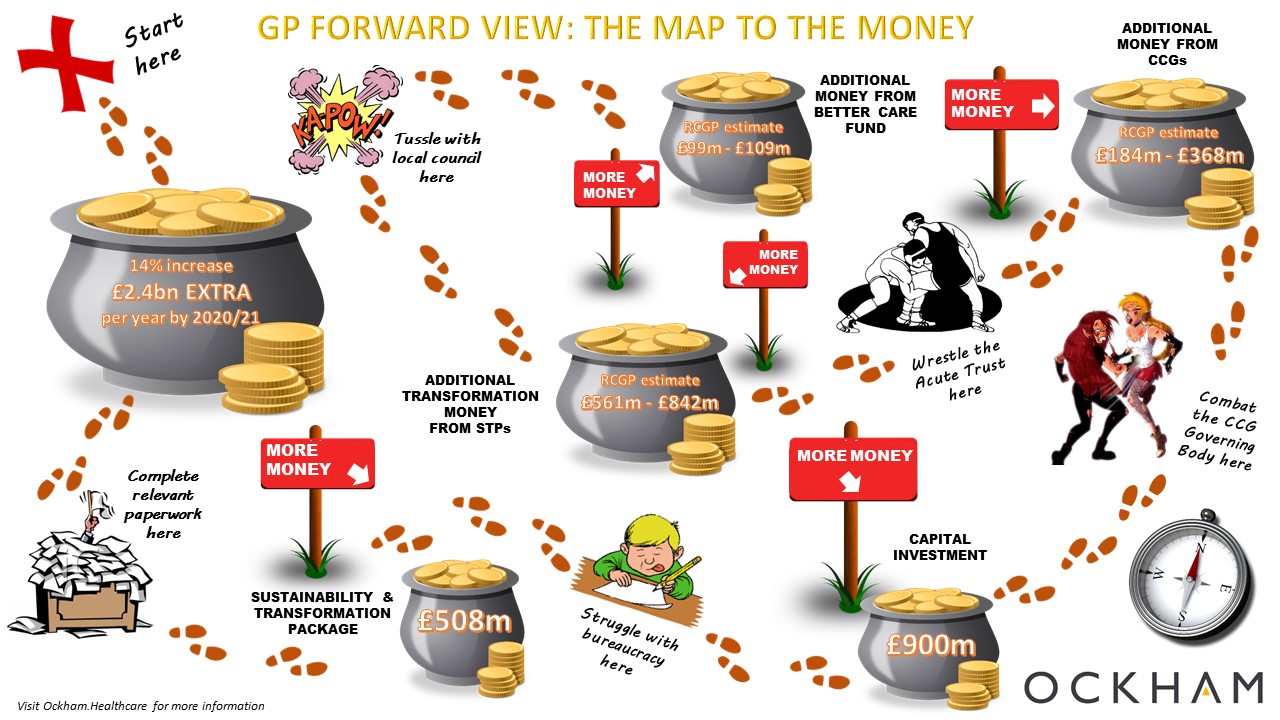
As with any radical new proposal, the document generates more questions than answers. But the overriding question I am left with is where do the incentives lie for General Practice? Remember it is voluntary, so it needs incentives. Maybe the model of an MCP, with its focus on population health and freedom to innovate, will be attractive enough for some. Maybe for others it will provide the way out they have been looking for (“GPs participating in an MCP may leave their current contractual arrangements permanently. They might contribute their existing GP partnership for a share of the MCP partnership or equity” p27). Maybe there will be freedom within the new contractual arrangements for each practice or groups of practices to create an outcome that is beneficial for them. Maybe it will be the only way to access the additional £2.4bn General Practice has been promised and needs to survive. Maybe I have missed something…

The document presents a new future for General Practice, as part of a wider team delivering care for a local population through an MCP. But it is a dense and difficult document, not targeted specifically at GPs – written instead I would say with GPs in mind. General Practice may only be one part of an MCP, but an MCP potentially represents the whole of the future for General Practice, which is why this document is so important.

How CCGs can partner with locum GP Chambers

In the third of our series of articles on CCGs and local locum GP chambers, we explore how CCGs can work with the local chambers once it has been established, and how the partnership between the two can benefit local practices, patients and the wider healthcare system.

Once a chambers has been established locally, CCGs can partner with them to put together a programme to offer training and other services to local practices. This programme can include:

Practice Improvement. The chambers can collect regular feedback on each practice from its GP locums and sensitively provide constructive feedback to help practices improve their working relationship with its clinicians. It can also play an active role in identifying local best practice and spreading it to other areas (e.g. appointment systems, DNA policies and procedures etc.)

Backfill to create GP time for CCG business. GPs often cannot attend CCG meetings because no locums are available. Local locum GP chambers can work in partnership with the CCG and use their local workforce intelligence to ensure these meetings are organised at a date and time when backfill can be arranged.

Practice Manager Training. The Chambers can put on workshops for practice managers on how to make the best use of locum GPs, including elements such as getting their feedback on your practice, how to make sure locums want to keep working at your practice, avoiding risk and complaints, and spreading best practice.

GP Locum Training. The chambers can provide training for locums to include elements such as high quality referrals, improved prescribing, supporting continuity by writing better notes, being involved in clinical governance, increasing effectiveness as a locum by giving better feedback, engaging with the practice, risk management and clinical handover.

Workforce Planning. Commissioners and the chambers working together proactively can ensure an effective use of the local GP locum workforce to help manage and avoid workforce issues, including holidays, sickness, winter, out of hours and weekends.

Service Provision. As with other GPs, many GP locums have specialist skills e.g. women’s health, dermatology etc. As locum GPs these skills are often under-utilised, but within the chambers model, these skills can easily be deployed across the CCG when and where they’re needed.

Direct locum Involvement in CCGs. CCGs and local locum GP chambers can work together to better involve the dedicated pool of flexible locum GPs so that they are more involved with commissioning, especially building on their experience in working in lots of different practices across the patch.

Some local GP locum chambers may be prepared to go a step further, and consider a scheme for the chambers to support local General Practice. In such a scheme the CCG would contribute the administration costs of the running of the chambers (rather than this being paid directly by the locum GPs themselves). In return the locums would offer to meet specific needs the CCG has. The table below provides an illustration of some of the potential elements of this scheme.

GP locums open up their availability five months in advance Often, GP locums will only make themselves available one month in advance. Incentivising them to open their availability to 5 months would enable better and longer term planning by local practices.
Practice-blacklist amnesty A locum agrees a trial of returning to work in a practice they have otherwise chosen not to work in. Appropriate safeguards are agreed in advance, and feedback is given after the assignment to identify issues and solutions.
At busy times (Christmas, Easter etc), enter into a ‘holding pattern’ Typically, well organised practices book well in advance, and struggling practices book when they are ‘desperate’. The ‘holding pattern’ would entail a commitment by the GP locum to work, but the location is only announced when local practices have been assessed on a needs basis by the commissioner.
Minimum commitment Locums agree to a minimum level of service e.g. four sessions per week.
Time ringfence A commitment is made by the locum to give first choice to the sponsoring CCG up until a set time period, after which the locum can make themselves available elsewhere.
Backfill If a practice is in crisis, local experienced partners can be deployed to the failing practice, whilst the chambers deploys a group of chambers locums in the donor practice to reduce loss of continuity.
Attendance at clinical governance meeting Already a requirement of many chambers, regular attendance at internal clinical governance meetings to discuss significant events, complaints and feedback about practices.

 Whilst such a scheme is not currently in existence, the Chairman of the National Association of Sessional GPs (NASGP) Dr Richard Fieldhouse believes the potential of such a scheme to be huge. He says, “As a system we consistently fail to make the most of the opportunity that locum GPs provide. The Chambers model enables effective partnerships to be developed between commissioners and locum GPs, and a scheme like this is the logical next step”.

Does the PACS model mean the takeover of General Practice by the local hospital?

When the new models of care were first introduced in the Five Year Forward View, there was concern in some quarters of General Practice that the PACS model (Primary and Acute Care Systems) could herald the takeover of General Practice by local hospitals. Ben observes that this is far from what is actually happening…

When I read of the Symphony Programme in Yeovil, one of the PACS vanguards, it looked like this indeed was what was happening. A number of local practices – initially 3, then 6, and potentially 10 – were reportedly joining a company, Symphony Healthcare Services, which is wholly owned by Yeovil hospital.

I contacted Dr Berge Balian, a GP and the Chair of the South Somerset Symphony Programme Board, to find out whether the rumours were true, and if so why the local GP practices were allowing this to happen. We spoke, and what I discovered was surprising. He kindly agreed that we could use the conversation as a podcast, which you can find here.

The first surprising point is the focus on General Practice, and developing it to play a leading, sustainable role in the delivery of care, through an enhanced primary care model. This includes incorporating health coaches within practices, as well as extending the care team to include mental health, pharmacy, and therapists.

The second is the starting point for working together: both General Practice and the acute hospital are experiencing the same pressures, of demand, recruitment, and finances. There was a realisation in conversations between the two that by combining they could more effectively meet these problems. As Berge puts it, ‘The ultimate outcome is that the hospital is going to shrink’, as it focuses on doing only what it absolutely needs to do. Working together provides the mechanism for moving resources, whether money or personnel, from secondary to primary care, in ways that could alleviate pressure on both sides.

Berge was an LMC chair. He knows General Practice inside out, and has its best interests at heart. Inspired by the vision of the Chief Executive at Yeovil Hospital he took on a role there as Associate Medical Director for Primary Care. Together with the Chief Executive they began building bridges between the hospital and the local practices. Berge knew change in General Practice starts by building trust, and he recounts 18 months of conversations that they had with all of the local practices, strengthening relationships and ironing out problems. A key part of the battle, Berge recounted, was convincing the practices this was not a clandestine way to negatively impact General Practice.

What happened next was most interesting. A number of local practices became so overwhelmed with their own problems they approached the hospital directly wanting to formally merge with them. The hospital considered this, but Berge wanted to ensure the valuable G/PMS contracts, which are contracts in perpetuity, were protected. As a result, they set up a complicated set of arrangements (under the banner of Symphony Healthcare Services) that means the existing contract is preserved, the organisation is at arms-length from the hospital, it is led by primary care clinicians, and the lead partners have a ‘right to return’ to their original contracts in future.

Impressed by the hospital’s commitment to making this work for General Practice, another 6 or 7 practices have expressed an interest in fully integrating with the hospital through Symphony Healthcare Services. And not just the ones in trouble. As Berge says,

About half are motivated by some challenges they are having, but another half really just see the future of General Practice being in a different model to the historical smaller partnership model.”

The integration of the practices with the hospital is built on what are described as “three pillars”: to preserve the individual identity of each practice; to share administrative and back office functions across the practices and the hospital; and to redesign the healthcare system, through the enhanced primary care model and shifting how care is provided for patients.

When asked about the future, what Berge sees as key is keeping primary care at the centre. His focus is on ensuring that those practices that have chosen not to ‘integrate’ with the hospital will stay at the centre of this work, shaping how resources are shifted from secondary to primary care.

At the end of the conversation I was not left thinking the local hospital had taken over local General Practice. Rather I was impressed by the way the hospital had enabled integration to take place by working to meet the needs of the local practices, and ensuring practices remain in the driving seat.

Three steps to CCGs supporting the development of local locum GP chambers

Ockham Healthcare is running a series of podcasts and blogs on local locum GP chambers because of the impact they can have on an area struggling with GP recruitment. In this second blog in our series Ben Gowland calls on CCGs to do what they can to support their development – but warns against trying to control them.

The idea of having a local locum GP Chambers in the patch can be very attractive for Clinical Commissioning Groups (CCGs). The advantages are clear (see my previous blog “10 reasons why your area needs a local locum GP chambers” here.), and it is a tangible way in which CCGs can be seen to be actively supporting local practices cope with the shortage of GPs.

The challenge comes because the establishment of the chambers lies outside of the control of the CCG. It is not as simple as deciding one is needed, and then charging someone within the CCG with setting one up and persuading a few locum GPs to join to get it off the ground.

This is because the chambers will only work if they are owned by the locum GPs themselves. And for them, the CCG-led model is not attractive. GP locum Dr Caroline Chill puts it like this, “If chambers are controlled by CCGs it makes being a locum less attractive, because it almost becomes a zero-hours contract with the terms and conditions being dictated by the practices using the service”.

All, however, is not lost! The idea of local locum GP chambers is attractive. It is attractive to some existing locum GPs who feel isolated and unsupported, to newly qualified GPs wanting to become a locum, and to GPs working in GP practices who for whatever reason do not want to continue in a specific practice but do not want to stop practicing as a GP altogether.

In all of our conversations with locum GPs working in local chambers, they described how they knew they wanted to be able to locum with peer support, but if they did not already know an existing local chambers they had to search to find out about the model. Unless one already exists locally, most GPs still do not know about them.

Step 1: Publicise the model locally. To start off with, you are unlikely to know who the potential GP members of the chambers will be. The aim is to connect those GPs who would like to be part of a local locum GP chambers (but might not know it yet!) with the idea of it. Publicising the model, and presenting it as something that gives locums control (rather than taking it away) will help make that connection.

Creating something from nothing requires a certain type of person. While some like to join something that already exists, there are those whose preference is to create something new and build it from scratch. It requires a certain level of drive and energy, and from our conversations with members of local chambers it is clear that this generally comes from one individual to start off with, who then draws in others along the way.

Step 2: Identify a leader. In order for the model to take off locally, the CCG will need to use all of its networks and contacts within the GP community to find a locum GP who wants to lead its development. Dr Mark Sage, a GP locum who set up the West Kent chambers, suggested the place to look would be either, “the well-established locums in an area, or the more recently qualified doctors, who are looking for a group they can affiliate with”. He suggested Programme Directors on VTS courses are important contacts, as they know the plans of the GPs leaving the course.

To be clear, this individual is not creating the chambers for the CCG, but for themselves. However, setting up something new is difficult as it requires a leap of faith that it is going to work, and can be challenging for someone who has never done anything like this before.

Step 3: Provide support for the leader. When we spoke to those who set up new chambers about the support they needed or received, this was not financial but rather moral support in terms of encouragement that the new model is going to work. The only practical action they described was help with the business case, in particular establishing the level of demand for locums from each of the local practices so that the newly formed chambers could be clear there would be sufficient demand for their business. Every chambers has since found that demand far exceeds the capacity they can provide!

In conclusion, it is clear from our research that, whilst successful locum GP chambers cannot be set-up nor controlled by a CCG, every CCG has a role to play in creating the environment in which they can flourish.

The future of General Practice is a jigsaw – will all the pieces fit?

I am worried. I worry that the General Practice Forward View (GPFV) does not fit with everything else that is going on. I worry that while on the one hand there is a small national team desperately trying to do the right thing by General Practice, most people haven’t even read the key document.

Recent events (and not just the obvious) have compounded my fears. Two things have happened. First the new CCG assessment and improvement framework has been published. It is not a fun read. The upshot of it is that there are 57 indicators across 29 areas by which CCGs are going to be assessed. One of these 29 areas is primary medical care, and it has a total of 4 indicators. These are:

  1. Management of long term conditions: unplanned hospitalisation rates for patients with chronic ambulatory care sensitive conditions.
  2. Patient experience of GP services: weighted percentage of people rating their experience of GP services as “fairly good” or “very good”.
  3. Primary care access: percentage of practices within a CCG where patients have the option of accessing pre-bookable appointments outside Monday to Friday 8.30am to 6.30pm. Access may be through a hub or federation rather than the individual practice.
  4. Primary care workforce: number of GPs and practice nurses (full time equivalent) per 1000 weighted patients by CCG.

I won’t waste the next 500 words explaining just why these in no way reflect the ambitions for General Practice outlined in the GPFV (but feel free to get in touch if you want the debate!). Suffice to say the measures by which CCGs are to be judged do not reflect the GPFV stated intentions around investment, workforce, workload, infrastructure and care redesign. Instead it is two steps backwards with tired measures that feel increasingly distant from the reality of most GP practices.

Second is the growing role of Sustainability and Transformation Plans (STPs). Recent guidance on STP allocations stated that this funding, “represents the full amount of funding expected to be available for local health systems from all sources in 20/21. They include an indicative fair share of the sustainability funding, primary care access and transformation funds, and other transformation funds including technology…. This includes taking forward the programmes set out in the General Practice Forward View and delivering extended GP access.”

The guidance goes on to say, “STPs will be the single application and approval process for being accepted onto programmes with transformational funding from 2017/18 onwards. Phasing of funding by areas in years 2017/18 – 2019/20 will be subject to consideration of STP plans submitted and subsequent decisions on how to target and deploy funding”.

The implication is that the financial plan for investment in General Practice actually sits within the local STP plan. While this contains a certain logic, the risk of the General Practice funding not finding its intended target becomes much higher. There is already guidance about the requirement of STP money to be passed through to acute providers, alongside a paucity of core General Practice provision representation in the development of STP plans in many areas.

The GPFV can’t sit in splendid isolation. It needs ownership across the system. It has to be the basis for how CCGs and primary care commissioners are assessed. It has to become the framework for local investment in, and the development of, General Practice. It has to materially impact local STPs. When we see the STPs we will find out exactly how reflective they are of the GPFV, and I really hope I will discover I have been worrying over nothing.

Page 85 of 89
183848586878889