
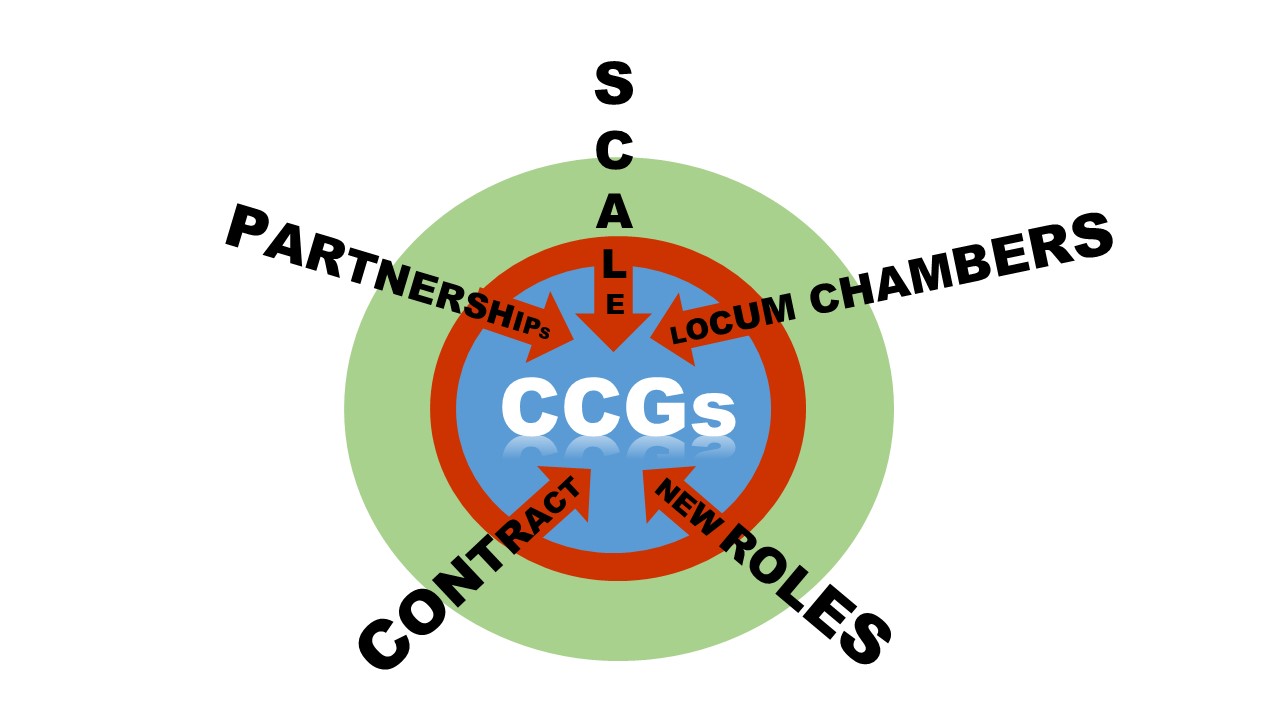
Will GP leaders let go of their CCG babies

The time has come, suggests Ben Gowland, for GP leaders in CCGs to consider moving from their role in the CCG to a leadership role in the development of core general practice. 

I have suggested this before.  The reaction seems to be determined by where the individual is sitting: if they are in General Practice without involvement in the CCG they are generally in favour.  However, if they are in a CCG they are generally against.

Initially I thought this was because of the money.  GP sessions are rewarded (often handsomely) by CCGs, to the point where some GP leaders can no longer afford to give up their CCG role.  Indeed, whoever the GP, if their time is no longer funded, it is lost, as it will be swept up in the tides of unrelenting demand on their practice.  I suggested that CCGs continue to fund their time, as part of its work to support the transformation of General Practice, by seconding them back to General Practice.

This would work.  But the objection is not primarily about the funding.  The main objection is the need of the CCGs for GP leaders.  How could there be clinically led commissioning if the GPs are leading the development of core General Practice instead?

Here we get into a debate about priorities.  We have to weigh up two different things.  On the one hand we should consider the influence of commissioning on the system.  If valuable GP leadership time is to be spent in CCGs, it has to be worthwhile.  On the other hand, we should consider the needs of General Practice, and the impact that GP leadership time could have there, and the impact this would have on the system.

Recently Simon Stevens, the Chief Executive of NHS England, has suggested ‘combined authorities’ for the NHS.  He wants to bring together commissioners and providers in order to simplify decision making and service change, based on the 44 STP (system and transformation plan) areas.  What this means is an end to any notion of a ‘commissioner-led’ NHS.  The reality is the NHS is currently regulator-led, and the role of commissioners is becoming increasingly unclear.

General Practice, on the other hand, is deep into a crisis of its own.  In short, demand is up and GP capacity to cope with the demand is down, and costs continue to rise while income has fallen to a smaller and smaller share of total NHS income.  At the same time, General Practice is purported to be at the centre of the new models of care at the heart of the five year forward view for the NHS.

In simple terms, the influence of GPs going forward is likely to be much greater as providers within any new models of care than through any commissioning organisation.  For this influence to become a reality GPs need to be organising a voice around the table, and developing an ability to take on the system integration role envisaged for it.  This requires transformation, and transformation requires GP leadership.

The emotional attachment GP leaders have to the CCGs many of them created is understandable.  But the world has changed significantly in the last few years.  It is time to re-evaluate. It is hard to put CCGs higher up the priority list than the development and transformation of General Practice.  CCGs have developed and are old enough now to cope without the intense parenting they have had so far from their GP leaders.  Now it really is time for these GPs to let go of CCGs and focus their efforts where they are needed most – back home.

Integration and Little Green Fairies

Ben Gowland muses on the potential roles for GPs in the integration agenda and finds himself away with the fairies.

I recently asked a GP whether she felt that GPs should play a leading role in integration across the system. She peered at me through her half-rimmed spectacles, and said, “I don’t even have time to go to the loo let alone get involved in Integration. It sounds great in theory but there is more chance of little green fairies doing a magic dance at the bottom of my garden than there is of me taking on any more work.”

So that was me told. The RCGP have produced a new report entitled, ‘The Future of GP Collaborative Working’. You can find it here. The report, as far as I can tell, has two key messages. One is that GPs, as the expert medical generalists, have a key role to play in the integration of services around patients with increasingly complex needs. The second message is that this central role of GPs is often not recognised and that any additional funding generally either falls short of what is needed, or is not maintained over the longer term.

So we are left with something of a conundrum. This is the ‘little green fairy’ problem; GPs now exist under such extremely severe time constraints that the prospect of them taking on more and more system responsibility seems, to many, simply preposterous. There are not enough GPs and no prospect of there being enough any time soon. But, at the same time, the system requires GPs to play a greater role in bringing services together around the needs of patients.

The RCGP Report contains a number of really interesting examples of how GPs have taken a leading role in integration. They are worth a closer look. They fall into three groups. There is one whereby a new service has been created that employs GPs directly into a new service, for example the @home scheme in London and the Memory Assessment Service in Brighton. There is a second whereby a small number of GPs are upskilled in a specific specialty and then work in partnership with a specialist centre to improve the General Practice offering, e.g. the child health hubs/clinics in London and in Lerwick in the Shetland Isles. The third is one whereby the GP practice team is expanded, for example the addition of a prescribing pharmacist as a partner, or employing a mental health therapist.

The analysis required is of the impact of these developments upon General Practice overall. Integration does not replace the need for core General Practice. Rather, it aims to fill the hole that often exists between core General Practice and secondary care, and indeed other services. But filling that hole at the expense of the core General Practice service would clearly be a mistake (a point, I fear, that is missed by some new-models-of-care enthusiasts).

This isn’t wholly scientific, but here is the little green fairy analysis of these three groups of examples:

Group One could either attract new GPs into the profession by creating a new range of options for newly qualified GPs to choose from, or it could pull from an already too small pool and make it smaller. Little green fairy verdict: I’m dancing.

Group Two can enable a small number of GPs to develop an interest, receive proper support, and enable that to be monetised by the practices of those GPs to recruit replacement capacity. At best the impact on GP practices is likely to be neutral. Little green fairy verdict: now you see me, now you don’t.

Group Three involves reshaping core General Practice by incorporating new roles and responsibilities as a driver for integration. This enables core General Practice to develop alongside integration initiatives. Little green fairy verdict: I’m toast.

We need integration; not as a replacement for General Practice but as well as General Practice. GPs have a key role to play. The only way this is going to be realistic at any sort of scale is if the integration work helps, rather than adds to, the delivery of core General Practice by GPs. If it doesn’t, then we would be better off looking at the end of our gardens for the elusive magic dance of the little green fairy.

We need new roles to enable change, not to replace GPs

Whatever may be inferred from the introduction of new clinical roles into General Practice, Ben Gowland argues that GPs are irreplaceable; no other health professional working in primary care has the depth and breadth of experience and training like a GP. However, the introduction of these other staff groups is, he suggests, a way of ensuring the survival of General Practice.

There is, unquestionably, a shortage of GPs. Practices need to be able to recruit GPs to fill the vacancies they have, and to avoid the financial burden of dependence on high cost locums. But practices with a full establishment of GPs still have a workload that is becoming increasingly unmanageable, and are also facing financial challenges as income has fallen and costs have risen over recent years. They cannot afford more GPs.

The new GP Forward View places the development of new clinical roles centrally alongside renewed efforts to attract and retain more GPs. As a result, the message that many GPs have heard (and rejected) is that somehow lesser-trained, lower-paid clinical professionals can carry out the work of a GP. But that is not why we need new clinical roles in General Practice.

We know that demand from patients has gone up to unmanageable levels and that clinical and non-clinical staff cannot cope with the daily onslaught. A recent study from the Kings Fund showed that the number of consultations has risen by 15% in the last 5 years. Patients are not just getting older, they are becoming much more demanding.

But if demand is up, and capacity (i.e. the number of GPs) cannot be increased to meet this demand, then something else has to change. This is at the heart of the introduction of new clinical roles.

The GP practices getting most on top of this are the ones that have embraced change in tackling on-the-day demand by, for instance, bringing in a multi-disciplinary teams of advanced nurse practitioners, paramedics and pharmacists. They have created in-house ‘urgent care centres’, or the like, that manage the telephone triage and act as the frontline for the practice.

Some GP practices have got together and created these ‘urgent care centres’ across different practices, to make them more affordable. Some have even merged so that they can do this more effectively. Some have teamed up with their local community trust so that they can access the nursing and physiotherapist workforce that they can supply.

The question practices need to address is not, ‘Can other clinical specialties carry out the role of a GP?’ Rather, the questions they need to ask are:

  • How can we re-shape the way that on the day demand is managed, using the skills, experience and expertise of other staff groups that are uniquely placed to be able to do this?
  • How can we meet the challenge that the new profile of demand presents for our practice?
  • How can we make best use of the GP time that we do have, while still meeting the needs of our population?’

If the aim is simply to replace ‘missing’ GPs with other staff groups, then attempts to introduce these staff groups to General Practice may well negatively impact the service practices can offer. But if the aim is to redesign the model of General Practice to better meet the shifting pattern of demand, then new roles can have a transformative effect on everyone working in a GP practice, and for the patients they serve.


Time for Action

Enough with the analysis and breast-beating, pleads Ben Gowland! As the system finally wakes up to the crisis in General Practice he posits that there is at least one reasonably easy solution which no-one has yet tried.

The Kings Fund have published a new report, entitled ‘Understanding Pressures in General Practice’. The immediate reaction in General Practice I am sure will be a weary shrug. They know what the pressures are. Their frustration lies in the amount of time it has taken the system to recognise it, and a prevailing sense that further analysis of the problem does not seem to lead to help and support that makes coping any easier.

There could be a real benefit to the quantification of the problem. There has been a 15% rise in consultations from 2010/11 to 2014/15, based on analysis of over 30 million contacts. This is driven by an increase in the number of consultations per registered patient per year from 4.29 to 4.91 over the same period. The benefit would be if this led to an increase in the funding per registered patient.

But the money has already been promised, through the General Practice Forward View (my take on that here). This report comes two weeks too late. For GP practices, the time now is not for further analysis of the problem, but for the development of solutions. We already know what money is available and what the policy makers are offering.

Ultimately it is now down to GP practices themselves. The GP Forward View is out, and it is decision time. But, realistically, how can GP practices possibly take a grip of this agenda? How will they find the time? When some GPs respond to surveys putting the need to be able to take a toilet break at the top of their wish-list, it is hard to imagine practices being able to create the necessary capacity.

There is one place that help could come to General Practice from. There is a group of GPs who understand the challenges General Practice faces, who know how the system works, who have relationships with different healthcare organisations across the system. These are the GPs working in CCGs.

These GPs work in CCGs because the CCGs pay them to do it. If they returned to General Practice they would lose both the funding and the protected time to really help. So right now the GPs that general practice needs are crusading the cause of CCGs, tackling the problems of the system. But while they are away, home is burning. At this rate, there may be nothing left to come home to.

The time has come for a really practical step. CCGs need to identify a core group of GPs that they will second back to General Practice, and fund these secondments. The job of these GPs will be to work with local practices to help them navigate a way through the post-GP Forward View landscape, and support the development of a strong local General Practice.

If General Practice really is at the heart of local Sustainability and Transformation Plans, it is a perfectly reasonable step for CCGs to take. If GP leaders in CCGs really want to make a difference, then it is time to focus on General Practice itself. Not from within the confines of the CCG offices, but out, hand in hand, with the practices who need the help.

The pressures in General Practice are now understood and documented. It is time for action. As Benjamin Disraeli said, “Action may not always bring happiness, but there is no happiness without action”.

Unpicking the Finances of the GP Forward View

Ben Gowland has read the new GP Forward View a number of times – despite its length! The question on his and everyone else’s lips is “Is there real coffee underneath the froth?”

The new GP Forward view is full of headline promises, but at the same time it is a marathon read (60 pages), repetitive and unwieldy.

Everything hinges on the money. The headline is an additional £2.4bn investment in General Practice. But what is that money, and is it really ‘additional’? How much will practices actually receive? You have to work hard to unpick this from the document, but here is how I think it breaks down:

This year’s GP contract (previously agreed) contains an uplift of 3.2%, totalling £220m. If this is replicated over the next 5 years General Practice will end up with a total funding rise of c£1.1bn. Remember, following the government’s 5-year funding settlement for the NHS at the end of 2015, NHS England had already promised investment in General Practice of 4-5% each year until 2020/21.

Capital investment of £900m. Capital investment promises to General Practice are hard to track. In 2014 £1bn was promised over 4 years from 2015/16 to 2019/20 as the General Practice Infrastructure Fund. This then became the Primary Care Transformation Fund, and then the Estates and Technology Transformation Fund. It looks like £100m of this was spent in 2015/16 (my assumption), and that the existing fund (£1bn less the £100m) has been re-announced as £900m with the deadline extended until 2021. We await the new name…

Recurrent investment of £500m for extra primary care capacity. This money is essentially for 7 day working, and is not for everyone. Hidden away in the document it explains this funding, “will be tested with the current GP access fund sites during 16/17”, meaning (I assume) it includes the funding NHS England has already promised to continue the services at the existing Prime Minister’s Challenge Fund sites. It will be “linked to” investment in 111 and out of hours, raising questions as to whether the money will even make it to core General Practice. This money is only accessible for “groups of local practices and other providers”.

These three pots together make a total uplift of £2.5bn, by my calculations. The promise is for £2.4bn, and the difference must therefore mean that the core expectation of GP practices should be that the annual rise in core contract value will be slightly less than that received this year, over the next 5 years. The only recurrent money that is ‘new’ is the additional funding available to those who pursue the government’s 7 day working agenda. More froth, it seems, than coffee.

This funding “will be supplemented by” a £508m sustainability package. This is essentially non-recurrent funding that will be invested over the next 5 years. It breaks down into 3 distinct pots:

  1. £56m of what is essentially crisis support: £40m to continue the £10m investment that was made into vulnerable practices in 2015/16 for another 4 years (bizarrely it is going to start with £16m investment in 2016/17); and £16m for specialist services for GPs suffering burn out and stress.
  2. £206m for ‘workforce measures’: the part funded pharmacist programme will be extended (£112m); a new Pharmacy Integration Fund (described as “£20m in 2016/17 and rising by £20m each year”) which is essentially for community pharmacy; a £15m practice nurse development programme; a £6m practice manager development programme; £3.5m in “multidisciplinary training hubs” to develop a wider workforce; plus an unspecified investment in GP recruitment and retention measures. 3000 new mental health therapists were also announced, but the document is silent on the source of funding for these.
  3. £246m to ‘support the redesign of services’: £45m to stimulate the uptake of online consultations; a £30m national development programme ‘Releasing Time for Patients’ for all GP practices; plus CCGs to come up with £171m to stimulate providers of extra capacity, to implement the 10 ‘high impact changes’ for General Practice, and to improve in-hours access.

So there you have it: the uplift in core funding over the next four years will be equal to or less than that received this year, the £500m of additional recurrent funding is not really available to the average practice, and at least half of the non-recurrent funding will be focussed on improving access. The lack of clarity in the document I suspect was designed to make the promise of funding look greater than it actually is, and on first reading it did exactly that. Once the reality of what is actually on offer sinks in, there may well be more heartache ahead for both General Practice and the Government.

Page 87 of 89
18586878889