
Extending the Primary Care Network

What is a network?  According to that modern day fount of all knowledge, Wikipedia, it is, “a set of human contacts known to an individual, with whom that individual would expect to interact at intervals to support a given set of activities. In other words, a personal network is a group of caring, dedicated people who are committed to maintain a relationship with a person in order to support a given set of activities.”

The key point here is that networks are based primarily on relationships.  So while Primary Care Networks (PCNs) may have originated through a contractual route, that shouldn’t be what defines them.  Rather the connectivity, interactions and mutual support of relationships are their lifeblood, and what will determine the impact they can have.

So far Primary Care Networks have, in the majority of cases, been made up of groups of GP practices.  Practices within a network have been building the relationships between themselves to build trust and enable joint working across practices.

But in the Network Contract DES Specification for 2019/20 it said, “There is no requirement for the Network Agreement that is signed by 30th June 2019 to include collaboration between practices and other providers, but this will need to be developed over 2019/20 and to be well developed by the beginning of 2020/21 when the Network Agreement will need to be updated to reflect the new Network Contract DES Specification.” (p11, 3.6).

If we leave the cloud having over next year’s Network Contract DES specification aside for a moment, then the logic of this requirement is sound.  If PCNs are based on relationships, then to make the maximum impact they need to include all those who can contribute to the cause.

But of course there is another way of looking at this.  The reason why practices were uncomfortable signing the network agreement in the first place was the potential impact on the practice’s autonomy.  Practices didn’t want to be told how they would have to operate by the other members of the PCN.  But at least all the other members of the PCN were GP practices, and so there was a level of shared interest.  Widening the membership to include non-GP practice organisations reduces practice autonomy further (less influence on PCN decision making), with less certainty that decisions made will be made in the best interest of my particular practice.

So there are two factors at play here: impact and trust.  For PCNs to have the maximum impact they need a broader set of relationships.  But without trust practices are going to be reluctant to include new members into the PCN family.

Networks must start with a common purpose (clarity on what we are trying to achieve).  Identifying who can help deliver this purpose and widening the membership to include them is the way to move forward.  Let the shared purpose determine the terms of any agreements that need to be made, but prioritise person to person relationships, because it is only when we trust each other that we can work effectively together to make change happen.

The mistake is going to be starting with the network agreements, ahead of building relationships and trust.

PCNs have the opportunity to establish a new way of working for the NHS.  Instead of the traditional top down, bureaucracy heavy, organisation centric way of working, PCNs can model a new style based on trust, relationships and commitment to a common cause.  Whatever the PCN DES specification ends up saying for next year about extending the membership, how PCNs extend their membership is going to be at least as important as who with.
Is it time to move away from centralised control of PCNs?

The biggest challenge the publication of the PCN DES specifications for next year has created is not so much the detail contained within the documents but the loss of enthusiasm amongst GPs for the whole PCN project.

Before Christmas there was hope that PCNs could mark a new dawn for general practice.  But that bubble was burst when the specifications demonstrated the lack of any national ambition to use PCNs to support the ailing profession.

Wherever the national negotiations end up, it is hard to believe they will restore the hope and energy that existed last year.  But PCNs don’t go from being a good thing to a bad thing overnight, and so it is worth taking some time to reflect on the opportunities PCNs create, regardless of national specifications.

A good place to start is the time before PCNs existed (remember that?).  There were two main trends in general practice, both a response to the pressures the service has been facing.  The first was the introduction of new roles, not to replace GPs but to manage those parts of the (growing) demand that their skills made them best placed to take on.  The second was the move to bigger practices and operating at scale, to develop the resilience of practices and to enable them to embrace any opportunities that develop.

PCNs continue both these trends.  The majority of the funding for PCNs is for the introduction of new roles, and PCNs bring practices together and provide the opportunity for the benefits of scale to be delivered across practices.

The big new opportunity the introduction of PCNs has created is working in partnership with other providers.  One of the rationales for PCNs was to enable the gap between primary care and the rest of the system to be closed, and to bring (in particular) general practice and community services closer together.

For GP practices PCNs create the opportunity to better meet the needs of the local population.  Practices can clarify what part of the local demand they are best placed to meet, and what part of the demand is best met by partners, by collaborations and by network wide services.  Where gaps in service provision exist PCNs can work with local partner organisations to fill these gaps.

In a world where we didn’t have PCNs what would general practice be doing?  Probably working towards the development of something that looks very much like PCNs…

So the problem is not primary care networks themselves.  PCNs enable general practice to respond effectively to the pressures they face and to better meet the demands they are under.  The issue lies with the PCN DES specifications which seem to be attempting to shift PCNs away from supporting general practice and into the generation of additional work that will make the current problems worse.

But that doesn’t make PCNs themselves a bad thing.  They remain the best hope for general practice for the future.  What has been revealed as the ‘bad thing’ is the level of control the national contract has over PCNs.  Leaving the destiny of PCNs in national hands already looks like a recipe for disaster.  So now may be a good time for practices and local systems to think carefully about exactly how they want to make PCNs work for them, and to exert more local control to restore the confidence of practices that PCNs can still be the path to a bright new future.

Why the new PCN DES Specification matters to everyone, not just general practice

There is a huge furore at present in general practice as a result of the publication of the draft PCN DES specification for 2020/21.  There are hugely detailed requirements on PCNs without any additional resource, and a clear expectation that the new workforce outlined in the 5 year GP contract last year is for additional work rather than to help meet the existing pressures in general practice.  Unsurprising, then, that general practice has reacted how it has.

But the implications of the draft specification go beyond general practice.  It is material to whether the shift away from the commissioner/provider split and towards integrated care, as outlined in the Long Term Plan, will succeed.

For integration to have an impact it needs local innovation, driven at a local level, based on trusting local relationships.  But as Integrated Care Systems (ICSs) and Integrated Care Partnerships (ICPs) try to meet testing national deadlines, their focus has shifted to governance, and the traditional NHS focus on accountability, control and decision making.

We have moved the deck chairs around enough times to know already that this will make no difference.  The one opportunity for it ‘to be different this time’ is PCNs.  Their 30-50,000 size enables real localism, borne out of an understanding of what is needed and what will work in each area, with person to person relationships as the enabler of making real change happen quickly.

The job of the architects of the new system really is to create the space, time and freedom for these local relationships to develop, for local problem solving to begin, and for local solutions to be developed.  So, for example, if a group of practices has a problem with the way district nursing is being delivered, instead of them raising that with the CCG to raise with the community trust in a contract meeting, who in turn will raise internally, and very little will happen, we move to a system where the practice leaders meet the district nurse leaders (who they already know) and work out what they can do differently to offer a better service to patients.  A system like this is one where things could start to be different.

The biggest problem with the PCN DES specification is the signal it gives that this will not be allowed to happen.  This is for three reasons.  The first is that if the centre dictates what PCNs should do in anything like the level of detail that is in the draft specifications, local innovation will not be able to flourish.  The mindset of central control has to be given up if integrated care is going to work, because the best solution in one area will not be the same in another, and each area needs the freedom to work out what will work best for them.

The second reason is that it has to be up to local areas to determine how they will use their workforce, and not nationally dictated.  The individual ‘return on investment’ mindset of any new funding, and a requirement for additionality even when core services are floundering, is fundamentally flawed.  We know we are 5-6,000 GPs short.  The new PCN-funded workforce can help both support general practice to thrive and be an enabler for local system working, but it has to be for local areas to decide how this workforce should be deployed across priorities (including core work), not via a nationally dictated contract.  Defining the “additionality” that new roles must deliver misses the point that existing (potentially more important) requirements cannot currently be met, and each local area has to be free to determine how to deploy the new roles to get the most out of them.

The third reason is that it takes time for local relationships to develop.  In year one we have had a primary focus on practice to practice relationships.  In year two we do need to widen that focus to the relationships across the wider group of providers within each network.  Time is needed for trust to develop, and over-burdening local areas with the level of delivery requirements contained in the draft specification at this stage runs a high risk of making relationships worse not better.  We need patience as we build a platform for future success.

My plea is for system leaders to recognise that the underpinning approach encapsulated within the PCN DES specification is one that will prevent the success of the new systems they are trying to create, and that it is not simply a general practice only contractual dispute.  If PCNs are really going to be the engine of integrated care, this contract needs to be an enabler not a dictator of local change.  Getting this contract right is everyone’s responsibility, and it would be great to see local leaders vocalising their own concerns about the issues the draft specification raises.

What to Make of the Draft PCN Service Specifications

The draft PCN service specifications were finally released just in time to put a dampener on Christmas for anyone eager enough to read them that quickly.  If you have avoided that particular pleasure so far, you can find them here.

It is worth stating right at the outset that the specifications have been published as draft, and that NHS England is seeking input/feedback from GPs (and “interested parties”), in the form of a survey (which you can access here).  The deadline for comments is the 15th January.  The final version of the specifications won’t be available until “early 2020”, when the contract for next year has been negotiated with the GPC, at which point we can look forward to “further detail for each requirement, followed by guidance”.

There were rumours circulating before these specifications were published that there would be no additional funding attached to support their delivery, and unfortunately these fears have been realised.  The guidance tries to make as much as it can of the existing funding that has come into general practice through PCNs (the practice funding for engagement, the £1.50 per head, and the funding for the new roles). It also suggests £75M will be available via the Investment and Impact Fund, meaning an “average” PCN could secure c£60,000 in 2020/21 via this route.

The problem is this funding has not felt significant to practices this year, and that is without any additional (unfunded) work being included.  More new roles are available to each PCN next year (with associated funding), but each one comes with its own 30% cost, and it is hard to see practices being motivated to put their hands in their pockets to carry out work on top of the work they already cannot cope with.

In an apparent attempt not to “overburden” the nascent PCNs, only two of the five specifications (medication reviews and enhanced health in care homes) are to be implemented in full next year.  The remaining three will be phased in over the next four years.  It seems there is at least some insight behind the guidance of just how these proposals are likely to land with most GPs.

Perhaps this is all an NHS England negotiating tactic.  Perhaps there is a plan to incite general uproar amongst the GP community, which will be quelled by the inclusion of additional resources at a later date.  The request for feedback and inclusion of a survey on the draft specifications does suggest that at least some parts of NHS England understand the implications of asking these specifications to be delivered unfunded.  However, it is entirely likely that senior parts of NHS England think that this is a reasonable ask of general practice, and so I doubt there is a grand plan or that the final outcome is fixed at this point.

It would be a shame if PCNs, who have come an extremely long way in a very short amount of time, are stopped in their tracks by such short-sightedness.  PCNs represent a major change to the fabric of general practice, and it is one that requires much more nurturing to succeed.  Where we are right now is that they are not at the point of irreversibility, and asking too much in too short a space of time without providing the necessary resources is likely to send many areas right back to the beginning.

But these are not the final versions.  As yet nothing is fixed in stone, and there is a whole round of contract negotiations to go through yet.  My advice to GPs is to send comments in nationally and to your local LMC.  Use the survey, although if doesn’t allow you to say what you want to say send your comments directly to england.networkscontract@nhs.net, and include what is needed to make delivery achievable.  Let’s not give up just yet, and let’s see if something positive can be salvaged out of what is admittedly a less that promising start.

Happy new year to you all!!

Guest Blog – David Cowan – A link worker has arrived. What do I do with them?

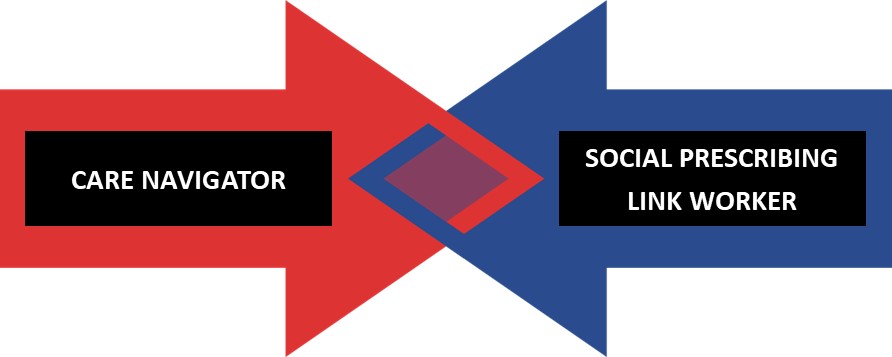
A number of new roles have been introduced into primary care over recent years. In this blog, I’ll focus on two ways that social prescribing is delivered, in particular, the active sign-poster referred to here as a care navigator, and the social prescribing link worker.

Care navigators are often primary care reception staff who have received appropriate training on options they can provide patients. The care navigator role should be seen as complimentary to social prescribing when viewed in terms of ‘as well as social prescribing’ not ‘instead of social prescribing’ (NHSE, Social Prescribing and Community Based Support 2019).

The four levels of social prescribing

Social prescribing as care navigation was identified as the first of four levels by Kimberlee (2015), who notes a growing evidence base for providing online information or leaflets in GP practices to help patients choose the most appropriate service.

The key aspect of differentiating the care navigator role, from other types of social prescribing, is the time the care navigator has with the patient. For the care navigator, it’s often a brief intervention with 30 seconds to a couple of minutes for the care navigator to identify the need and, if appropriate, offer the patient a choice between a GP appointment and an alternative healthcare professional.

Kimberlee (2015) goes on to say that ‘social prescribing light’ was the second level, led by the voluntary sector, including providing a point of contact and addressing a specific need, but no direct links with general practice.

‘Social prescribing medium’ is the third level identified by Kimberlee (2015) and includes a health-focused role, with a set number of visits, addressing healthy lifestyle choices through applied behaviour change techniques.

Finally, the fourth level of social prescribing identified by Kimberlee (2015) is ‘social prescribing holistic’ with a direct primary care referral to social prescribing link workers who may be based in general practice, but are employed by a local social prescribing community provider and focus on the persons self-identified needs.

What is the evidence social prescribing works?

Social prescribing can reduce demand for GP appointments.

A recent study published in the BMJ open journal by Kellezi et al (2019), asked 630 patients to complete a survey at the point of referral and again four months after they had received social prescribing.

There was a reported 25% reduction in healthcare appointments and decreased feelings of loneliness.

Dr Chris Dayson from Sheffield Hallam University has contributed towards the evidence base with several evaluations in Yorkshire, such as in Rotherham in 2014, Doncaster in 2016 and Bradford in 2017. These evaluations show a return on investment to the healthcare system, reductions in primary and secondary care demand as well as improvements in individual mental wellbeing scores.

Despite this, social prescribing evaluations often draw criticism for their lack of methodological rigour (Evidence to Inform the Commissioning of Social Prescribing, 2015).

Social prescribing, as signposting or care navigation, builds on the GP receptionist role, who for many years have helped patients choose a doctor or nurse appointment.

As the extended primary care team grows under the NHS Long Term Plan (2019), social prescribing link workers will benefit from spending time with care navigators:

  • By listening to the needs of patients who request GP appointments, they can flag appropriate referrals.
  • Working together GPs, link workers and care navigators can co-develop the systems and processes so that everyone feels confident for direct signposts away from GP appointments to a link worker.
  • There’s also the option of working with a care navigation training providerConexus Healthcare have trained over 10,000 care navigators across England and Wales, with an accredited care navigation training programme. Appropriate training and support is available to social prescribers with the introduction of a level 3 social prescribing qualification.

So, in a nutshell.

Working together, care navigators and link workers are able to play a greater role in helping patients access social prescribing.

So Mr Williams can directly access a social prescribing link worker, via a care navigator, for welfare and benefits advice. Miss Jenkins can feel less anxious about her housing issues because she’s being supported through each step of talking to her housing association. And Mrs Rupinder could wait just days, rather than weeks, to get extra help with her carer duties, thanks to both a care navigator and link worker.

An integrated care navigation and social prescribing service in primary care makes perfect sense. Patients can get the help they need sooner without the need to see a GP first and save finite GP appointments for patients with medical needs.

Dayson, C. (2014) The Social and Economic Impact of Social Prescribing. Available from: https://www4.shu.ac.uk/research/cresr/sites/shu.ac.uk/files/social-economic-impact-rotherham.pdf

Dayson, C. (2016) Doncaster Social Prescribing Service. Understanding Outcomes and Impact. Available from: https://www4.shu.ac.uk/research/cresr/sites/shu.ac.uk/files/eval-doncaster-social-prescribing-service.pdf

Dayson, C. (2017) Evaluation of HALE Community Connectors. Available from: https://www4.shu.ac.uk/research/cresr/sites/shu.ac.uk/files/eval-HALE-community-connectors-social-prescribing.pdf

Evidence to Inform the Commissioning of Social Prescribing (2015) University of York. Centre for Reviews and Dissemination. Available from: https://www.york.ac.uk/media/crd/Ev%20briefing_social_prescribing.pdf

Kellezi et al (2019) The social cure of social prescribing: a mixed-methods study on the benefits of social connectedness on quality and effectiveness of care provision. BMJ Open Journal. Available from: https://bmjopen.bmj.com/content/9/11/e033137

Kimberlee, R. (2015) What is social prescribing? Advances in Social Science Research Journal. Vol 2, No 1. Available from: https://blogs.ncvo.org.uk/wp-content/uploads/2016/02/what-is-social-prescibing.pdf

NHS England (2016) High Impact Action Case Study. Available from: https://www.england.nhs.uk/publication/west-wakefield-reception-care-navigation/

NHS England (2019) Social Prescribing and Community Based Support: Summary Guide. Available from: https://www.england.nhs.uk/publication/social-prescribing-and-community-based-support-summary-guide/

NHS England (2019) Long Term Plan. Available from: https://www.longtermplan.nhs.uk/

Page 52 of 89
1505152535489